Start with the calorie target
A healthy-looking batch still fails if it lands too high or too low for the dog eating it.
A balanced homemade dog food recipe is not just meat, rice, and vegetables. Most recipes miss calories, calcium, and repeatable portions even when they look healthy.
Most recipes fail because they miss calories, calcium, and repeatable portions even when they look healthy. This guide shows you how to build a homemade dog food recipe that actually works as a daily nutrition plan.
Want to check your recipe? Use the calculatorA healthy-looking batch still fails if it lands too high or too low for the dog eating it.
Protein, starch, fat, and calcium support should be chosen deliberately instead of piled into the bowl.
Before it becomes a routine, the recipe needs a nutrition review instead of a guess that it is balanced.
Quick example
Many 60 lb adult dogs land somewhere around 900 to 1,100 kcal per day, though the real target depends on the dog. A workable daily recipe might use chicken, sweet potato, spinach, oil, and a calcium source, but the exact amounts are what make the bowl repeatable.
The key distinction
This is one of the biggest mindset shifts in homemade feeding. Recipes usually go wrong when ingredient quality becomes the whole focus and calories, mineral balance, and repeatable structure never get checked properly.
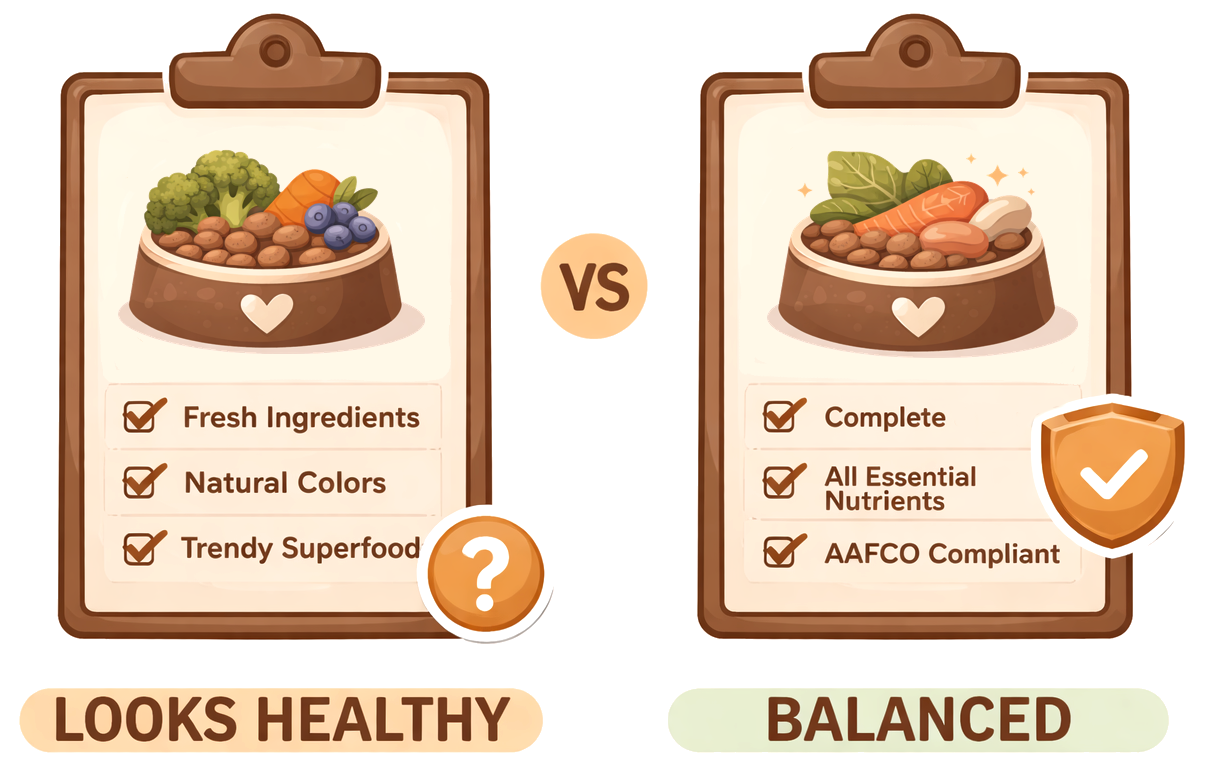
Looks healthy
More likely to be balanced
A recipe can use great ingredients and still be too low in calcium, trace minerals, or key vitamins.
Protein, fat, and carbohydrate ratios can help organize a recipe, but they do not guarantee the final diet is complete.
A well-built recipe can still miss the mark if the calorie target is wrong or the batch is fed inconsistently.
The useful question is not “what ingredients sound healthy?” It is “what does this recipe need in order to work as a repeatable diet for an actual dog?”
The recipe has to land in the right daily calorie range for the dog eating it.
Homemade recipes fail here constantly. Meat-heavy bowls are usually calcium-poor unless you plan for it.
Fresh ingredients do not automatically cover zinc, copper, iodine, vitamin D, vitamin E, and the rest.
A recipe only helps if you can portion it consistently and feed it the same way week after week.
Once the nutrition checks are clear, these are the parts you are actually shaping into a repeatable recipe.
A primary protein such as chicken, turkey, beef, eggs, or fish gives the recipe structure, but protein alone does not make it complete.
See ingredient guidesFat changes calorie density fast. That is one reason homemade food can drift if you change cuts of meat or add oils casually.
Check feeding-by-weightRice, oats, sweet potato, or another carbohydrate can help with energy, texture, fiber, and repeatable batch cooking.
Read the carb guideVegetables can add fiber, moisture, and variety, but they do not fix a recipe that is short on minerals or calories.
Browse safe ingredientsMany homemade recipes need more than whole ingredients alone. This is where calcium support, mineral coverage, and supplement decisions become part of building a safer routine.
Read the supplements guideMost homemade diets fail on completeness, not on ingredient quality. Owners tend to focus on freshness and visible whole foods while underestimating mineral balance, calorie consistency, and the hidden work done by supplementation.
If you want to go deeper on that part of the puzzle, start with this guide to supplements in homemade dog food.
Homemade feeding gets easier when you solve the big problems in the right order. Start with the dog, then the recipe, then the math, then the long-term routine.
Work out the daily calorie target first. A balanced recipe for one dog may be the wrong calorie level for another.
Pick the ingredients you actually plan to use repeatedly, then think about how rich, lean, or simple the recipe needs to be.
Homemade feeding gets safer when you analyze calories and ingredient totals instead of relying on a recipe that sounds healthy.
This is where you catch calcium issues, macro imbalance, and missing support before the recipe becomes a daily habit.
Searchers often want a clean ratio they can memorize. The problem is that a recipe can match a rough protein-fat-carb pattern and still miss calcium, vitamin D, zinc, iodine, or the right calorie density for the dog eating it.
Ratios are useful for organizing a batch. They are not a substitute for checking what the full recipe actually provides. That is why a “balanced homemade dog food recipe” is not just a percentage formula. It is a recipe that works nutritionally when you run the numbers.
If you are not sure what “broader mineral support” actually means, read when homemade dog food recipes need supplements.
If you are trying to picture the bowl, think in terms of a protein base, an energy source, vegetables or fiber support, and a deliberate calcium-mineral plan. That is a much better mental model than “meat plus a few healthy extras.”
Protein
Chicken, turkey, beef, eggs, fish
Energy
Fat source and recipe density
Structure
Rice, oats, sweet potato, or other carb choice
Fiber
Pumpkin, vegetables, texture support
Minerals
Calcium and broader nutrient support
Need the next layer of detail? Start with the supplements guide or the nutrition calculation guide, then move into the calculator to compare actual ingredients.
See the workflow in the app
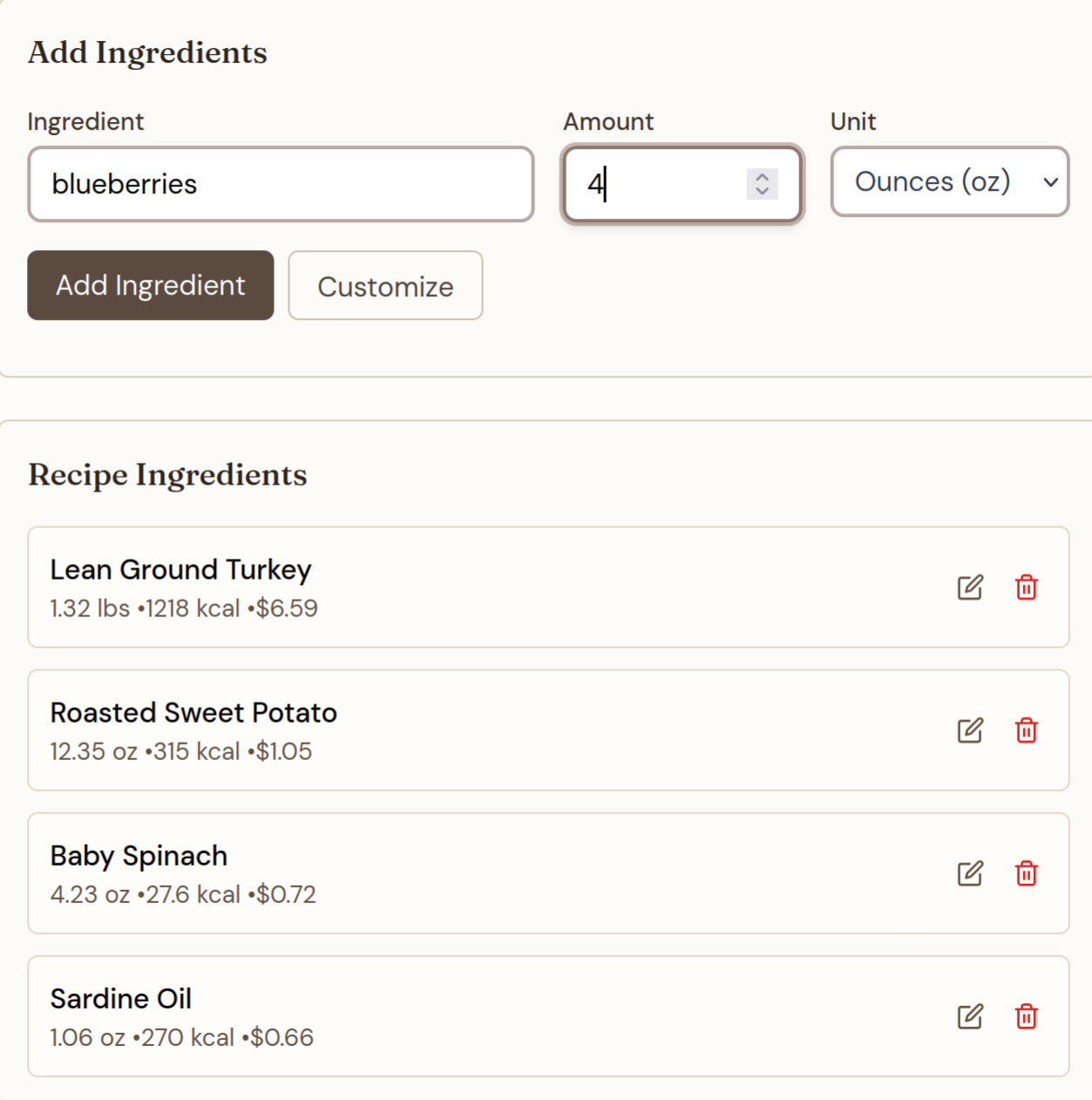
The jump from “I think this sounds healthy” to “I know what this recipe is doing” usually happens when ingredients, calories, and nutrition review are connected in one workflow.
Build the recipe, check the totals, and move into deeper nutrition review without switching between notes, spreadsheets, and separate tools.
If you want the logic behind that analysis, start with the nutrition calculation guide.
Recipe builder screenshot
A clearer way to keep ingredient decisions and recipe totals together.
Use this quick checklist for balance, calcium, portions, nutrient coverage, and recipe swaps before a batch becomes routine.
Open guideA practical guide to when fresh ingredients are not enough and what support homemade diets often still need.
Open guideUse a more practical comparison than “fresh food good, kibble bad.”
Open guideCalcium is one of the easiest nutrients to get wrong in homemade feeding, so this is a smart next step if you want to avoid common formulation mistakes.
Open guideHelpful for people over-focusing on “grain-free” or “no carbs” thinking.
Open guideGrowth diets are less forgiving and need tighter formulation.
Open guideOnce the recipe works, the next challenge is making it sustainable.
Open guideYes, but only if the recipe is built and reviewed as a long-term diet. Homemade dog food works best as a daily routine when calories, calcium, phosphorus, and broader nutrient coverage have been checked deliberately.
Not by themselves. Ratios can help you sketch a recipe, but they do not prove the diet covers calcium, trace minerals, vitamins, essential fatty acids, or appropriate calorie density.
Calcium is one of the most common problems because meat-heavy recipes are usually high in phosphorus and low in calcium unless a calcium source is added on purpose.
Usually not. That kind of bowl may look clean and wholesome, but it often needs calcium and broader vitamin and mineral support before it works as a repeatable long-term diet.
Many homemade diets do need some form of supplementation or mineral support. The exact answer depends on the recipe, but homemade feeding often falls short when owners assume fresh ingredients cover everything automatically.
You do not know by ingredient quality or appearance alone. You know by checking the calorie target, analyzing the recipe, and reviewing whether the nutrient profile and mineral balance make sense for the dog and life stage.
This page is meant to help you think more clearly about homemade feeding, not replace professional guidance. Puppies, pregnant dogs, large-breed growth, and dogs with medical conditions need more precise diet planning than a general guide can provide.
If you are building a homemade diet for long-term feeding, especially for a higher-risk case, work with your veterinarian or a board-certified veterinary nutritionist.
Once you understand what balanced homemade dog food requires, the next step is checking a real recipe. Use Pawprint Kitchen to compare ingredients, review calorie totals, and build a feeding plan that is easier to repeat.